No ingredient in perfumery carries more mythology per gram than oud. It is the scent of incense in old Arabic perfumery, of ceremony in Japanese and Indian cultures, of a material so rare and expensive that it crossed into Western perfumery as a synonym for luxury itself. The mythology is not empty. But the facts are stranger than the stories.
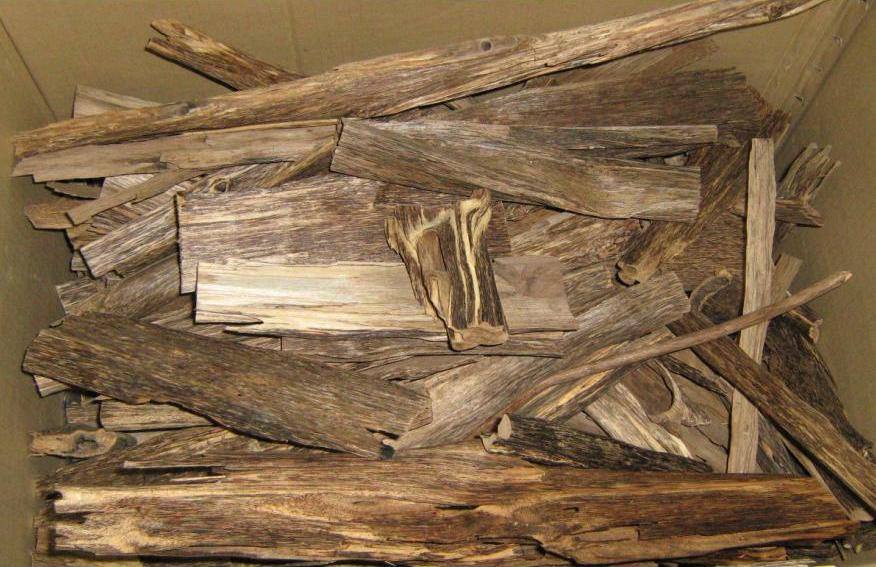
Oud begins as a wound. Agarwood is the resinous heartwood of fast-growing evergreen trees, usually of the Aquilaria genus, and it forms as a reaction to a fungal attack, which turns the usually pale, light wood into a dark, resinous wood with a distinct fragrance, a process that takes, in the Perfume Society's phrase, almost forever. The tree defends itself by saturating the infected tissue with resin, and only the infected wood carries the scent. Healthy Aquilaria smells of nothing at all.
A distinction matters here, and perfumers are careful with it. Agarwood is the infected wood itself, traded as chips for incense and ceremony. Oud, or oudh, is the oil distilled from it. The wood is the raw material; the oil is the perfume ingredient. Conflating the two is how most misunderstandings about the material begin, including misunderstandings about price: the chips and the oil are different markets with different scarcities.
The scent of natural oud, in the Perfume Society's description, is distinctively irresistible and attractive, with bitter sweet and woody nuances. Earthy to its core, it is the rare material that can smell ancient and animalic in one breath and refined in the next.
The aroma of natural oud is distinctively irresistible and attractive with bitter sweet and woody nuances: seriously earthy (and in small quantities, seriously sexy). (The Perfume Society)
The rarity is real, and the law has noticed. TRAFFIC, the wildlife trade monitoring network, states the legal position precisely: all Aquilaria species have been listed on CITES Appendix II since 2005, which regulates their international trade. That means the international trade in agarwood is controlled and documented. It does not mean every stick of wood is contraband, and the distinction matters to anyone buying oud today. Cultivated and plantation oud exists, including plantation-grown material from Vietnam noted by the Perfume Society, and it is traded legally. Whether it carries the same scent as wild-harvested material is a separate question, and perfumers answer it differently.
The pressure that made the treaty necessary is documented. TRAFFIC reports that illegal collection and trafficking of agarwood is on the rise with international demand, with close to 330 kilos seized by law enforcement in the Philippines between 2018 and 2021 and openly illegal online trade continuing. As oud has become more popular, the Perfume Society notes, high-quality material has become hard to source. Scarcity and desire move together, as they always do.
Perfumers have answered with synthesis. Synthetic oud exists, and the Perfume Society is blunt about the difference: trained noses will tell you that it smells plainer, woody and leathery, but without the warm, balsamic qualities. That is not a dismissal. It is a description of a different material that does some of the same work, and it sits at the center of an honest conversation about what natural oud is for and when it is worth its price. The honest houses label the difference. The best synthetic ouds are fine materials in their own right, and fine is not the same as identical.
The cultural history is older than the perfume trend by millennia. The Perfume Society describes oud as a key ingredient in old and new Arabic perfumery, renowned as an element within high-quality incense in Arabic, Japanese and Indian cultures. In those traditions the wood is burned, not worn: the chips release their scent as smoke, and the grading of the smoke is a connoisseurship of its own. Western perfumery met oud through the oil, but the wood came first, and in much of the world the wood is still the point.
The western chapter is recent. Oud has, in the Perfume Society's words, definitively crossed over to the west in the past few years: rare, seriously expensive, and increasingly hard to source in high quality as popularity grows. That crossing changed the material's meaning. In the east it is heritage; in the west it became a signal, the note that announces luxury before anything else is smelled. Both readings are true, and the tension between them is part of what you are paying for.
Oud is the ingredient that most clearly states perfumery's oldest tension: the most beautiful materials are the scarcest, and desire is the fastest route to extinction. The treaty, the plantations, the synthetics, all of it is an attempt to keep the scent without spending the forest. The wood remembers the wound. The question is whether perfumery can remember the wood without wounding the forest. Whether that attempt succeeds is the story of the next decade.