Culture
The Flacon as Object: A Century of Bottle Design
Long before the juice inside mattered, the bottle was the message, and one jeweler turned glassmaker rewrote it.
Long before the juice inside mattered, the bottle was the message, and one jeweler turned glassmaker rewrote it.
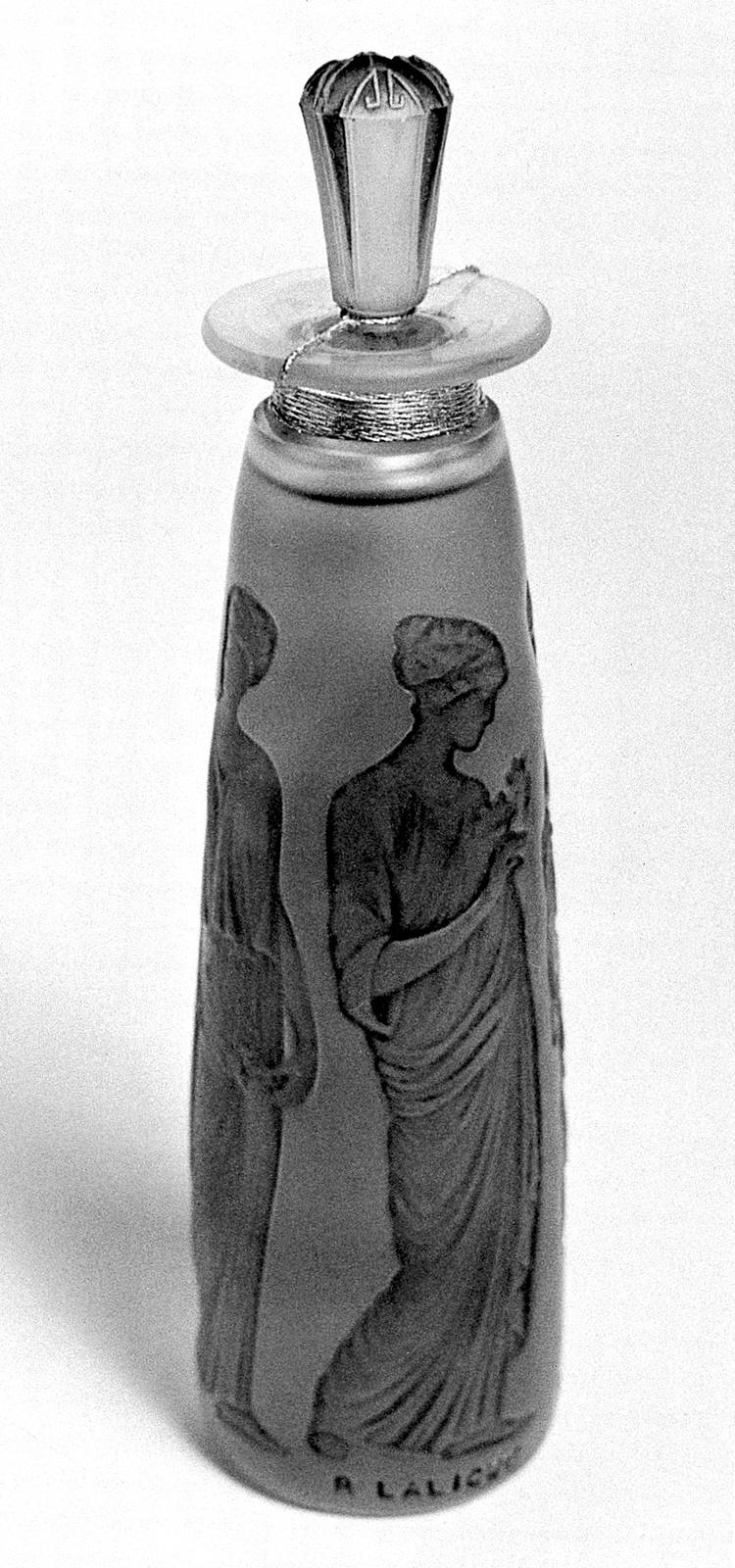
The photograph above shows a perfume bottle designed by René Lalique in Paris around 1910, made for Coty. It is small, frosted, and patinated in sepia tones, and it sits in the Wellcome Collection as a work of design rather than as packaging. That is the entire argument of the last century of perfume bottles in a single object: the flacon stopped being a container and became the brand.
The story properly begins with a broken bottle. In 1904, François Coty, a young Corsican perfumer newly returned to Paris, was struggling to sell his fragrance La Rose Jacqueminot until, as legend has it, he dropped a bottle in a department store and the spilled scent sold his entire stock within minutes. Coty understood the lesson instantly. An attractive bottle and presentation were not decoration. They were the sale. His first great scent went out in a Baccarat crystal bottle, and his most consequential collaborations were with René Lalique, the jeweler celebrated for his Art Nouveau work.
Lalique had opened his Paris shop in 1905. Coty was so taken with his designs that he asked him to create glass for his early scents, Ambre Antique and L'Origan. According to the auction house Quittenbaum, Lalique made perfume bottles for Coty for the first time from 1908, renting a glass workshop in Combs-la-Ville. His first label design for Coty, L'Effleurt, dates to 1907, initially a paper label on bottles made by Legras and Baccarat, then a glass label fused to crystal, and by 1909 a complete bottle of his own design. Over the years he would create sixteen bottles for Coty, plus designs for Guerlain, Worth, D'Orsay, and Roger & Gallet.
The search for the beautiful is more important than the display of luxury. (René Lalique)
What made Lalique's flacons radical was not only that a serious artist deigned to design them, but how he treated glass itself. He pioneered patination, firing semi-matte compounds onto molded glass to give his figures a frosted, insubstantial depth without sacrificing transparency. The stoppers became sculpture: the 1912 L'Effleurt prototype carries two facing cicadas. The bodies carried female figures in sepia patina, for Ambre Antique, L'Origan, and Cyclamen. The bottle was no longer a neutral vessel for the perfumer's liquid. It was an authored object with its own signature, literally: Lalique molded his name into the glass.
He was not working in a vacuum. In 1853, Pierre-François-Pascal Guerlain had commissioned the glassmaker Pochet du Courval to create the Bee bottle for Eau de Cologne Impériale, made for Empress Eugénie and covered in sixty-nine gilded bees, the emblem of the Empire. Guerlain's own account of the house history treats the bottle as inseparable from the commission. The message of the nineteenth century was prestige through craft. The message of Lalique and Coty was something newer: prestige through art, at industrial scale.
A century on, Lalique's bottles have completed the journey from packaging to patrimony. Original Coty flacons trade on the auction market as works of decorative art: a 1912 L'Effleurt prototype in molded and patinated glass, its stopper carved with two facing cicadas, has sold at auction for 5,500 euros, while early L'Origan and Ambre Antique bottles change hands on the specialist market for thousands. The molded signature, once a maker's mark, is now a certificate.
This afterlife confirms what Coty intuited in 1904. The bottle outlives the juice. Perfume evaporates; glass endures. Museums from the Wellcome Collection to the Musée International de la Parfumerie collect these flacons not as commercial ephemera but as design history, shelved beside the vases and the jewelry. The industry's current mania for the artist collaboration, the limited edition, the numbered flacon, is not a novelty. It is a homecoming.
That second idea is the one that survived. Once Coty proved that a bottle could carry a brand's identity, the flacon became architecture. The great houses learned to design silhouettes that could be recognized across a room and across a century: the Bee bottle still anchors Guerlain's identity more than 170 years on, and Lalique's frosted figures set the template for the artist-designed limited edition that every maison now issues. The bottle tells you what kind of luxury you are buying before the cap comes off.
There is a quiet irony in this. Perfume is invisible, and its packaging is the only part of the product you can see. A century ago, a jeweler who had given up jewelry for glass understood that the vessel could be the message. The industry has been elaborating on his insight ever since, one patinated stopper at a time. Walk the perfume hall of any great department store today and you are walking through his legacy: a hundred small sculptures, each promising that the invisible thing inside is worth the visible craft outside.
One letter each week: what mattered in perfumery, and what to smell next.
Free. Unsubscribe anytime.